Tuesday, September 7, 2010

Poverty and Joy

By Clarissa

I am occasionally caught with that far off look of longing when I see someone with the latest apple gadget (read here iPad or iPhone 4). Though I know it cognitively, I must continually repeat to myself that getting said item will not bring me lasting happiness and technological paradise on earth.

When we were in Kenya this summer, I had the opportunity to meet someone who John and spent much time with on his previous trip to Kenya.


Joyce is full of life, but most of us would not say that her life is full. At least not by the standard that we often use. She has never been to the beach. She eats almost the same thing every day. There is no running water in her home. She doesn't go to concerts, or shop for new clothes, or google things whenever she has a question. And she definitely does not have an iPhone.

And yet her smile is constantly be spilling out. Joy seems to eek out of her. Even when talking about her concerns for where money will come from to send her kids to school, there is a radiance about her that can only be described as the aroma of Christ.

She invited us to spend a day with her at her home in Kibera and we felt like royalty as she proudly welcomed us into her humble dwelling.

She asked us about our families, what hardships we had endured in life and listened compassionately as we shared some of our own struggles. Struggles, that while very real to us, seemed somehow a lot less important as we sat in the middle of the largest slum in Africa.

Joyce and her family are a constant reminder to me. A reminder that true joy is found in knowing that God's goodness does not hinge on my circumstances. And certainly a reminder that having the newest and coolest apple thing will not bring all the happiness that the commercials promise.

Joyce's Kitchen

Joyce's oldest and youngest.

Some of the wonderful meal prepared for us!

She showed us her neighbor's Sakuma Wiki Garden. It seems miraculous that anything green can grow in Kibera. The kale-like greens are grown in sacks so that in the event of an emergency they can take them with them.

These three beautiful girls were sitting on a pile of garbage just outside Joyce's home.

Saturday, August 21, 2010

Into Southern Sudan, Part 1

Note: We are finally back in the states! However, we still have lots of pictures and stories that we have not had a chance to blog about, so we will slowly be adding new blog posts over the next few weeks to try and catch up with all the stuff we still have to share.

We find ourselves in bed, under a mosquito net, thanking Jesus for the rain the previous day that had broken the muggy heat of Lokichoggio. Outside of our window we can hear the village just on the other side of the fence clapping and signing. I can only imagine the tall guant Turkana people bouncing in their traditional turkana hop dance. Ornate bead work rattling around their necks & bright blankets gleaming in the firelight.

I can hear a goat bleating in between the sharp claps and I wonder if he is dinner. What are they celebrating? Some unique tribal holiday, or perhaps receiving of food relief?

Flying up to Lokichoggio takes only 2 1/2 hours. It is flight that replaces two solid days of driving. On the way we passed a river that caught the sun so that it looked like a liquid gold flowing between lush green forests I thought as we crossed it that this must be some of the most beautiful country in the world. Soon after that river the deep green faded to rusty brown. Instead of sparkling rivers we saw dry beds, vacant of any moisture. In the rainy seasons these smears turn to rivers but now they are mocking reminders of thirst. I was awed by the contrast and wondered how anyone could live in such a desolate place.


We stayed in Lokichoggio for two nights with a missionary family, of which the husband is a pilot. On the third day we joined him on a flight into Sudan.

The Turkana people who live in the Northern dessert-land of Kenya are like the environment. Harsh and thorny. They are not precisely hostile, but they are not like other Kenyans who are smiling at you before they even know you. They have a nomadic history and settled in the Lokichoggio area because it was possible to dig down into the dried river where, a few feet beneath the dusty surface, there is water.

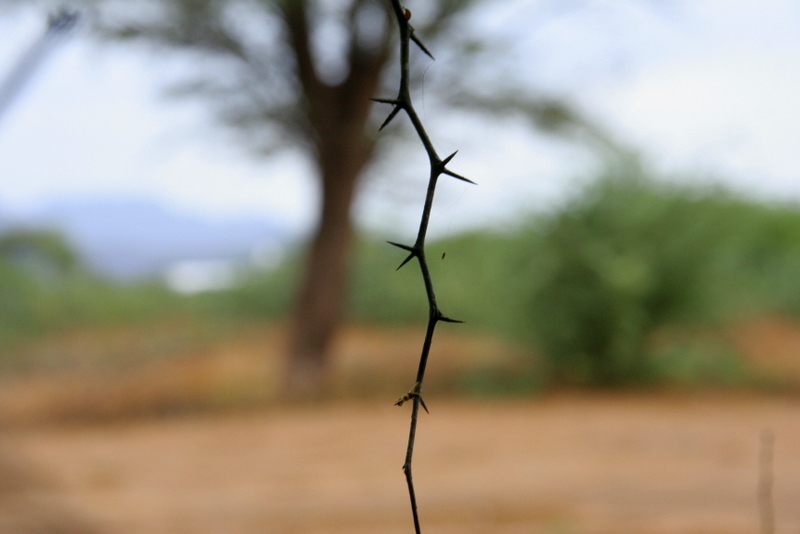
There were tons of bushes and trees with huge thorns. Needless to say, the environment did not have a very friendly feel to it.
Because we were just passing through and did not have the opportunity to build relationships with any of the Turkana people, we didn't want to take their picture blatantly and offend them. However, this website has great photos of the Turkana people.

A desert rose, one of the few splashes of color we saw.

An aerial view of the dried river bed in Lokichoggio.

This house where we stayed was built by a Austrian man in the 70's. It is made entirely out of containers.

Why Sudan?
Sudan has been in the news a lot recently. Perhaps too much as it is easy to tune it out. Twenty years of bloody civil war has earned the country a spot on the genocide list. At least 2.5 million people have been displaced in the Darfur region as a result of the conflict, and it is estimated that as many as 400,000 people have been slaughtered. Being the largest country in Africa and having 597 different tribes, the needs in Sudan are vast and deep. One AIM Air pilot estimated that as much as 75% of the flying that AIM does is into Sudan. Because of the instability of Sudan, historically many humanitarian and mission organizations have had to be based outside of the country. Kenya, being a stable country and sharing a bit of border with Sudan is an ideal place to have a base for flying in and out. Lokichoggio, located in the northeastern corner of Kenya, is only 20 miles from the border. It is hot, dry, and remote.


Lokichoggio is still strategic, it is still a vital part of the ministry of AIM Air to Sudan, enough that two pilots and their families are based there.


Because of Lokichoggio's ideal location, at the height of the genocide and conflict in Sudan, this place was the largest UN base in the world. They built a road from the airport into town, a road which is now so dilapidated and and full of massive potholes, that everyone actually drives on the side of the road instead.


Friday, August 20, 2010

Into Southern Sudan, Part 2


Note: This is part two of a segment that seemed to long to have all as a single post. If you have not read part one, you can read it here.

Leaving the Lokichoggio airport and heading into Sudan in the Cessna Caravan, we flew over two hours of jungle, briefly inerupted by rusty earthen ribbons winding their muddy way through the dense foliage. Our first stop was to be be in the remote village of Akot (home of the Dinka people) at a hospital where we would be dropping off 4 months worth of medical supplies. We landed on a dirt strip and taxied up onto a small concrete platform. The hospital is small, there is only one doctor, and a few nurses that rotate in and out. They have facilities to manage many more patients than they have but not the staffing. They are surrounded by lush green jungle and isolated by poor roads but still people come from miles away for treatment because they are the only hospital in the area. For more information and pictures of the Akot Medical Mission, check out their website.

The back of our plane, full of supplies for the hospital.

We flew over the Nile River!

John actually got to spend quite a bit of time flying the plane.

An aerial view of the mission hospital in Akot.

Getting ready to land on the dirt airstrip.

Unloading Supplies

Some of the kids from the village came out to see the airplane and help unload supplies.


During a short tour of the hospital, we learned that while there is technically a road that they can take to get to a larger city, there is a very high chance of being carjacked, and that the roads are absolutely impassable during the rainy seasons (of which there are two, each lasting multiple months). Getting to see first hand how much this ministry is dependent on aviation has given us an eagerness to continue pressing on to the goal of serving long term in Africa.

As we were flying out, we actually saw some of this impassable road. We also saw some of the huts that the Dinka people live in.


After dropping off the supplies at the hospital, we stopped at Lopit, a Sudanese village nestled into the crook of a small mountain. We dropped off Victor, a Sudanese pastor who had been trying to get across the border back into Sudan, to bring building supplies for churches and homes damaged by the war, and had been prevented. Our stop was quick, only a few minuets, so we did not get to see what was happening there, but here is a story of an AIM missionary who is working among the Lopit people.

Perched on the side of a hill, the Lopit people build their houses very close together, much closer than in most other villages around Southern Sudan.

We had planned to land in Nagishot, a village up in the Didinga hills of southern Sudan, but unfortunately the airstrip was covered in clouds, and we were unable to land. This is an area in which there are no roads. Other than aircraft, there is no way of access for missionaries carrying the life-giving Word. Flying over this area, perched high up in the mountains, it was obvious that without the airstrip and the planes that flew into it, there would be no missionaries there. Here is a video that some missionaries put together who are serving with the Didinga people. This is a link to a Blog of a young woman serving the Didinga people with AIM.


Though our trip into Sudan was short, we were able to experience first hand how the ministry of aviation is truly serving dozens of other ministries. Our hearts feel full when we think about the privilege we have of, in a small way, being a part of such a vast array of ministries that God is using to serve Eastern Africa.

Tuesday, August 17, 2010

The hanger through a 50mm lens

Our Canon f1.8 50mm lens is great for taking close up shots, and since it was the last day at the hanger, Claire came and took a bunch of shots. So, here is a day at the hanger through a 50mm lens.