Saturday, July 31, 2010

On the hanger floor


A bustling center for safari, commercial, and private flights as well as a wide variety of humanitarian flights, Wilson Airport is also home to Africa Inland Mission’s hanger. Walking around it is not uncommon to see airplanes with logos for Red Cross or the UN World Food Program. They are constant visual reminders that we are in a place surrounded by much need. Wilson Airport is, in fact, the busiest airport in Africa. Nairobi is a major base for flights into the most remote and difficult to access places of Eastern Africa. Places like the Democratic Republic of Congo and Southern Sudan, places so torn apart by war and instability that something as basic as roads, and healthcare and food are virtually absent. Places which are hard on the people and hard on the airplanes, making well-trained pilots and mechanics essential. Being here makes us thankful to currently be training these much needed people at Moody, as well as eager to move here ourselves to contribute to the work being done.

AIM has a video that was put together as they were evaluating the needs of the hard to reach central region. You can watch it here. Be warned you might feel the need to get up and go!

Move Against the Fear from AIM On-Field Media on Vimeo.


The AIM Air hanger is not only staffed by missionaries but also by national staff, and walking around, it becomes apparent that Kenyan faces far outnumber wazungu (whites). We have the distinct privilege of working with our Christian brothers (and a few sisters as well) who often have as much of a desire to serve the church as we do. In many ways some of them make far more sacrifices than we ever will. The Kenyan aviation maintenance system is difficult to navigate (and full of corrupt bureaucracy), so part of what AIM Air does is work to help the national staff to get their Kenyan mechanics licenses. The Kenyans range in experience, from those who have been working for longer than I have been alive and have much to teach us, to those who have not even completed school.


One day Claire and the other wives came to visit for lunch. Claire got to have the same lunch that John orders every day from a man who comes to the hangar and delivers Kenyan style food.


Claire was ecstatic that there was a cargo crate from Prince Edward Island, she kept squealing, “this box came from the home of Anne of Green Gables!”


The hanger has over ten aircraft in its fleet: Three Cessna Caravans, one DC-3, one King Air, one Cessna 2-10, and five Cessna 206s. Here are a few of them after the hanger was closed up for the day.


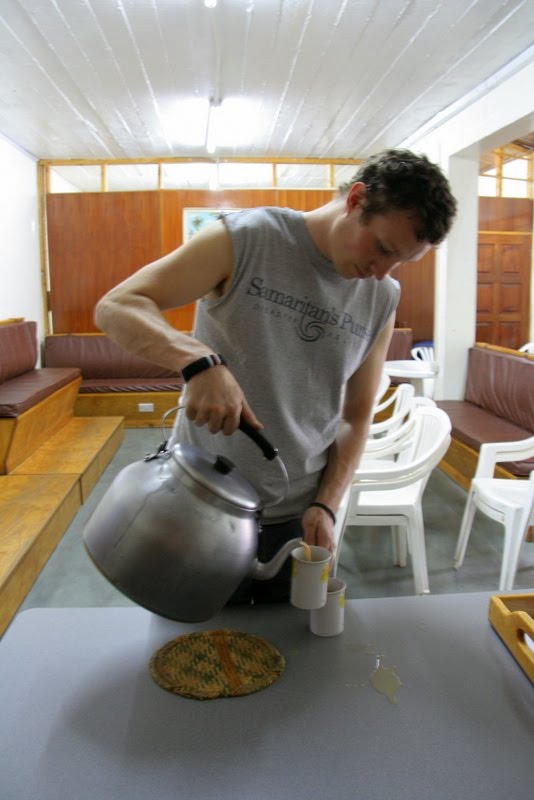
The Kenyans take their Chai (tea) breaks very seriously, everyday midmorning and midafternoon. Here is John pouring a cup of afternoon Chai.


Monday, July 19, 2010

Elephants, Giraffes, and Warthogs! Oh My!


We were recently able to see some of the wildlife of Kenya up close and on one account VERY personal. Thankfully, these encounters were within the confines of fences with wildlife experts and gamekeepers nearby.

The Sheldrick Wildlife Orphanage brings in baby elephants and rhinos who have been abandoned due to mothers being poached or injured. Were were able to visit the orphanage and see some of the baby elephants being fed, though apparently the rhinos don’t do so well with lots of people, so we didn’t get to see them.


When the baby elephants are brought in, one gamekeeper becomes more or less their mother for the next potentially 10 years as they are slowly introduced into the wild. The game keepers even sleep with the elephants!


On the same day, we also stopped by a giraffe center that allows you to feed giraffes and they will even kiss you! (if you put food in your mouth). Needless to say, John was willing to try, while Clarissa was not.


I guess the warthogs are friends with the giraffes because they were wandering around their feet the whole time.

Tuesday, July 13, 2010

Even Dickens would be at a loss for words…

by Clarissa

Being the literature fiend that I am, I often see things through the lens of great authors. I am reminded of how Charles Dickens wrote prolifically about the poverty he witnessed in industrialized London. He labored to use his pen to raise awareness of the horrendous conditions endured by children living in the city. And yet, as we visited two slums in Nairobi this past week, I found myself thinking that even he would have been challenged to portray what is there.


This past week James took us to visit a church/school that he serves at in the heart of Kibera. It is true that words cannot really describe Kibera. Poverty, squalor, filth can come close, but there is a depth of suffering and resilience that can only be understood when walking though looking into the faces of the residents. Right in the middle of Kibera is a Christian school, run by a church and also working in partnership with Compassion International. Our group walked through the gate and we were stormed by hundreds of little children crying “wazungu” which means “white people.” Speaking with the headmaster we were told that many of these children have lost parents to AIDs and live on less than 2 dollars a day. Surrounded by such precious little faces, suddenly all the ridiculous concerns that I normally carry around seemed to dissolve.


As I pray about how I will spend my time in serving the people here when we move here in the next few years, I can’t imagine living so close to these little ones, and not taking time to be with them. On Thursday I will be going back with two other wives to read stories to the kids and then leave them with some books. Pray that as we spend time with them that God will communicate to them that they are loved and valued.


This painting was in the church...I love it.

Living in the Heart of Nairobi

After arriving in Nairobi, it took us a few days to get over jet lag and be oriented to our new surroundings. Our team is staying at Mayfield guest house. A cozy establishment owned by Africa Inland Mission that offers comfortable rooms, common living rooms and three square meals a day.

The entire establishment is run by Kenyans who have been quite helpful in learning Swahili, and they only laugh at our bizarre Americanisms occasionally. James and Samual are two of our favorites and they both have a wonderful sense of humor and are always joking with us.

This is James

Mayfield, like pretty much every other building (aside from the slum) is surrounded by a wall with barbed wire and has big steel gate with a guard 24/7. Crime is a huge problem so everyone tries to make their property look less vulnerable than the next guys’.


This is the little house where the gate guard sits all day and night.

Also included in our orientation was “transportation lessons” which consisted of James teaching us how to ride the Matatus (a.k.a suicide vans). These 15 passenger vans careen around Nairobi taking over every spare inch of pavement, even if that pavement happens to be the lane of oncoming traffic. There seems to be no rhyme or reason to where they stop and how much they charge you, making it a daily adventure.

Goats blocking the road are a common occurrence.

Beyond the gates of Mayfield, Nairobi fits the profile of a big city in a developing country. Plumes of diesel smoke being spewed above a never ending snake of traffic, bicyclists hauling all manner of freight, roadside vendors taking advantage of the traffic to hawk their wares to weary drivers, sprawling slums with open sewage, people burning piles of garbage, and small children running about seemingly unsupervised.

We have started to settle into a rhythm here. Monday through Friday 8-5, eight members so our team take matatus to Wilson Airport where they are serving in the AIM Air hanger doing much needed maintenance to airplanes that are constantly enduring African runways. Clarissa and two other wives, plus 2 young children have the opportunity to connect with other wives of AIM Air pilots and mechanics as well as serve in various ministries around Nairobi.

This friendly little Chameleon was a bit timid, but didn't seem to mind us picking him up.

Monday, June 28, 2010

Next Stop Nairobi!

Washington, Idaho, Montana, South Dakota, Minnesota, Wisconsi, Illinois, Ohio, Pennsylvania, New York.....Next stop (and final destination) Nairobi!

We have traveled over 3000miles, and have not yet even left the states. We were able to see Mt Rushmore, and Crazy Horse national monuments along with the infamous Wall Drug in South Dakota. We saw a huge lightning storm over southern Minnesota and were able to detour through Niagara Falls on the way into Syracuse, NY where John’s family is living.

Thursday we are getting on an airplane with our team (11 of us + two children)-- half of whom we just met today-- and travel approximately 8 hours by plane to Amsterdam, have a quick 2 hour layover there and then another 8 hours to Nairobi.

However; the biggest distance we will have to cross will be the divide between all our expectations for this trip and actual reality. Regardless of how much experience we may think we have or don’t have, we construct an image of what we want or hope. It may be as simple as what we will have for dinner, or as uncontrollable as how a team that has no previous relationships will gel together in an unfamiliar environment.

We will try and share our experiences of having these expectations dashed or pleasantly fulfilled over the course of our trip.


Here are a few of our attempts to capture sights from our travels to get this far.


Before heading East, we detoured through Seattle to visit some of Clarissa's family. This is Hannah, Clarissa's second cousin.


Start them early.


Ah, Pike Place Market...so many memories (for Clarissa anyway).


After heading East, we camped the first night in Montana, and there was a peacock living at the campground!


Driving through the Black Hills of South Dakota, we snatched a shot of this guy standing next to the road.


A roadtrip doesn't really feel complete without a stop at a National Monument, so we managed to make it to Mount Rushmore.


If you have never been to Wall Drug in South Dakota, it is worth stopping, though without a doubt it is a major tourist trap.


I am pretty sure this was a taxadermied horse...uh...weird.


Because of major storms, we could not camp the second night, but we were able to snatch this picture of the lighting that was lighting up the sky. It is official. Midwest storms are A.MAZ.ING.


Apparently our trip would not be complete without getting stuck in Chicago traffic.


We also managed to make it to Niagara Falls. Impressive, but utterly run over with tourists...I guess it is to be expected.


Midwest = Corn, therefore here is a picture of corn growing in John's grandparents garden in Ohio.


We finally made it to Syracuse to spend time with John's parents and sister. This is from a walk we took through a nature area near their house.

Tuesday, June 1, 2010

Memories of My Previous Trip to Nairobi

By John

When I went to Nairobi in 2006, I got to know a woman named Joyce, who lived with her family in the Kibera slum. One day she invited me to visit her. The following is a reflection of my afternoon visiting her. I hope that I will get to see her this summer and that Clarissa, too, will have the opportunity to meet her.

Myself, Jeremy (my roommate at the time) and two of Dawn and Ryan’s boys, Caleb (5) and Levi (3), got dropped off like the spoiled white Americans we are and met up with Joyce’ brother her husband and her two boys. We made our way through a makeshift bus station that was clogged with fifteen passenger vans stuffed with too many sweating bodies, and black diesel smoke. We made our way down a dirt side street lined with little dukas that sold American hats and taped music, that they would blare.

We came out of this dark cramped ally into an open area with dukas on both sides, divided by a railroad track with steel ties, presumably to protect against termites. The shops amid the squalor were bright splashes of color; remarkably clean and well kept clothing hung for sale in a rickety duka that was made of crooked sticks and tarps hung where corrugated steel roof could not be found. We paced the ties down what feels like a kilometer under the African sun to a look out spot where as far as we can see in the distance are the rusted steel roofs of Kibera. Dirty, and stained red brown, like the African earth, the slum stretched out into the horizon.

Just below our lookout, amid a pile of garbage, a teenage girl stared, the whites of her eyes standing out against her dark skin. Mutely, she watched as we snap photos of a novelty, and she lives in that hole.

We turned and walked back the way we came, going the long way around to Joyce’s house so that we might see more of Kibera. We made our way down garbage-paved streets, past little barber shops, dukas selling cokes and phone cards, people staring with large eyes. We passed churches with loud sound systems pumping their Swahili sermons into the dusty lanes. The walls of the shacks alternate between mud slapped around an exposed structure of gnarled sticks, and steel with faded advertisements for cigarettes.

We arrived at a little gate large enough for Caleb to walk through unhindered. We passed between mud houses into a little open area with 4 or 5 doors facing each other, wet laundry strung across the gap.

We entered the house, built on a cement slab, assembled of mud and sticks and topped with a rusty steel roof that leaks in the rain. In front of us and to the left, once my eyes adjusted to the dark interior, hung two light blue sheets hanging from the ceiling and reaching to the floor. To the left was Joyce’s bedroom; ahead was the boys’ room, which was just a mattress and a window in the wall. A couch and two chairs were set up around a coffee table, the couches were really just benches covered in bright green knitted blankets with some cushions underneath. Inside it was cooler, but I could still feel the perspiration running down my back. Joyce met us with a big smile and a strong handshake. She gave us sweet rolls that she had made in our kitchen the day before along with chi. We sat and talked the boys went out to play with a warning from Joyce to stay close by. We talked of Kibera while Joyce and her niece labored in the corner they called a kitchen. Lunch came as beans, Ugali, a stew with mystery meat, Sukuma wikki, and chapattis. First taste of the pasty grits like Ugali, not bad, a bit bland but you could live off it…whether I could thrive on it…probably not.


We speak of school and the cost it takes to send kids to secondary school. Their oldest will be in form one in another year. 10,000 Kenyan shillings(approximately $130) or more for three months--a fortune for Joyce. The going rate for work was maybe $6 a day. The kids are getting tired, and I am sickened at heart enough that I don’t want to be there any more. I feel too rich, too blessed. I don’t want to answer when they ask me if I have a car. I don’t want to answer when they ask me about America.

I have been thinking about the passage in Luke that talks about those who have been given much being required much. I have seen a bit of what that means. People born in poverty don’t ask to suffer, they don’t ask to go hungry. They don’t go looking for difficulty; it all comes to them. He wants me to ask to suffer, to ask to go hungry, to look for difficult places to live. He calls me to ask, to as Christ did, volunteer for the pain. To know comfort, to know ease, and to give it up for His Glory. I am frustrated and tired and just want to tell Him to go away, but as the disciples said, “to whom shall I go, He has the words of Life.”

Monday, May 10, 2010

Out of Africa, or rather into it Part, 2

If you didn't get a chance to read our first post, you can read it here: Out of Africa, or rather into it, Part 1

Picking up our lives and moving to the other side of the planet, we have hundreds of questions. Questions about culture, people, transportation, food, health, raising children, etc. We are thankful that our trip this summer will enable us to better prepare as best we can for life there. Knowing what to expect can avert some of the frustration,
disillusionment, culture shock, culture blunders, etc. that we are bound to experience in some ways regardless of how well we try to prepare ourselves.

So many questions...
  • Which of my clothes should I give away, and which would be appropriate for living in Africa?
  • Should we bring any of our keepsakes or should they be packed away and stored with family?
  • What does the Church in Africa look like? How can we join God in the ways He is already working there?
  • Should we bring our bikes to get around? Will it be safe to ride our bikes around the city? Should we buy bikes there?
  • In what ways will Clarissa serve (we already know there are dozens of possibilities)? Should she bring all of her teaching materials?
  • What tools will John need that he cannot get there? To what extent should we try to purchase some of those tools now?
This summer we will get to see first hand and bring back stories of what God is doing in East Africa. We anticipate that we will be stretched and blessed by our African brothers and sisters. We will have the honor of worshiping God in a different language and learning from the Kenyans what it means to live life in community.

Please pray that through this trip we will catch a vision for what it will look like to live life in Nairobi, to pour ourselves out in relationships to our neighbors, through working in aviation, and through serving "the least of these." God has blessed us to be a blessing, and we want to know, "What does it look like to be a blessing in Africa?" We want to go as learners. Learning from Africans about their own culture, learning from other westerners about how to best fit into society and learning from God what it means to humbly serve those who are different than we are.